
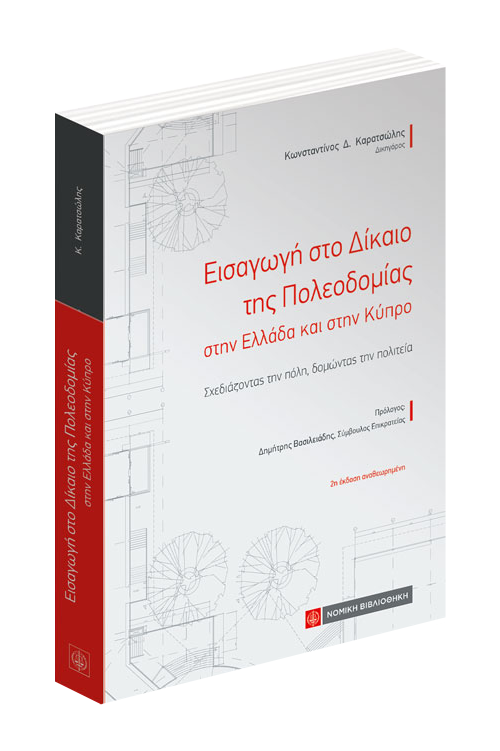
- Author K. Karatsolis
- Foreword D. Vasileiadis
- Edition 2nd, 2022
- ISBN 978-960-654-063-9
- Format 17 × 24 cm
- Pages 336
Designing the City, Building the Polity
The book «Introduction to Urban Planning Law in Greece and Cyprus – Designing the City, Building the Polity» offers a comprehensive analysis of one of the most technical branches of law: Urban Planning Law. The work describes issues of particular importance which, owing to their significance, are the subject of detailed analysis, and it highlights the common difficulties encountered in Greece and Cyprus in practically implementing sound urban plans that comply with the standards set by legislation and theory.
The book comprises three parts: the first two deal with urban and spatial planning law in Greece and Cyprus, while the third sets out the theoretical approaches to urban planning law. An effort has been made to render specialized legal terms and texts easily comprehensible to scientists from non-legal fields and, conversely, to make plans, technical terms, and technical specifications accessible to readers lacking a corresponding background.
This effort is further reinforced by the inclusion of tables and diagrams — a feature that constitutes an innovation in Greek legal literature — thereby contributing to a more holistic approach to matters relating to Urban Planning Law. In this light, the book is addressed to young scientists and students of law, political science, and social science, as well as of polytechnic schools, drawn from the academic community of Greece or Cyprus alike.
A Few Words About the Book
In building the city, human beings essentially redefine themselves, delineating the framework of social coexistence and creating a normative order for the environment in which they live. Through this order, our culture, our state’s self-image, and the characteristics we attribute to our tradition and outlook are, to a large extent, shaped. Yet the individual’s freedom to create and progressively transform the city in which they dwell remains a neglected right.
In recent years, the wave of “enclosures” dividing neighborhoods into “safe” and unsafe areas, the practices of spatial control, the lack of respect for the environment, and the violation of laws and aesthetic rules have all taken on new dimensions as a result of the global recession.
And as individual margins often narrow to a suffocating degree for the overwhelming majority of people, interest in the city’s common goods is now being revived.
Answers to these and many other issues raised in the book are provided daily through Urban Planning Law, its interaction with other branches of law, and, ultimately, their practical application: construction, both public and private, as well as open spaces.
In the book, the reader is able to compare the current urban planning regime of Greek and Cypriot society and identify similarities and differences. Furthermore, the reader can deepen their understanding through a study combining the current rules and procedures provided for under Urban Planning Law with their application.
Through the faithful application of Urban Planning Law, citizens can exercise their right to the city with a view to literally building a better world — which is why this book bears the title «Designing the City – Building the Polity».
In an accessible manner and in clear language, the book aims and attempts to:
a) analyze, from a legal standpoint, the philosophy of city planning and the related factors that play a role in quality of life, the protection of nature, the preservation and promotion of cultural monuments, and the citizen’s right to their space,
b) explain, through codification, the planning tools and the administrative procedure for issuing regulatory and administrative acts of an urban planning nature and for the protection of architectural and cultural heritage,
c) examine parallel institutional tools and pieces of legislation, originating from the field of environmental law, that exert a direct influence on city planning and on the perception of urban and spatial planning, thereby showing that Urban Planning Law is not clearly delimited but rather interdependent with neighboring branches of law and forms part of the broader family of Environmental Law,
d) present, on a comparative basis, the different European approaches to specific issues of Urban Planning Law,
e) compare the current urban planning regime of the Greek and Cypriot states and identify similarities and differences,
f) bring to the forefront of engagement with Urban Planning Law issues the concepts of resilience and sustainability of cities — concepts of particular relevance also on account of the climate crisis — through reference to the importance of Sustainable Urban Mobility Plans (SUMPs),
g) delve into the legal dimension of issues such as public space, the protection of the cultural environment, and SUMPs, highlighting, on the one hand, their importance for the future of cities and, on the other hand, the need for Urban Planning Law to be enriched by these matters