
“Marine Coastal Ecosystems and Human Activity in the Year 2022 – Codification and Recording of the Existing Law”, first published in Journal “Nomiko Vima”, March – April 2022 Issue, Athens Bar Association.

The article examines the critical role of marine coastal ecosystems for environmental balance and human wellbeing, noting that they are increasingly threatened by climate change, extreme natural phenomena, tourism pressures, construction, and other human activities. Although the existing legal framework provides mechanisms for protection and sustainable use, the authors underline that it remains fragmented and insufficiently equipped to address the interconnected nature of marine and terrestrial ecosystems.

They emphasize that effective protection depends on robust enforcement, pointing to persistent challenges such as illegal constructions, unregulated tourism, and poor waste management, all of which undermine coastal resilience. A key institutional gap is the absence of comprehensive Marine Spatial Planning, which creates uncertainty and enables arbitrary decisions in coastal and marine areas.

The authors argue that the framework must be continuously updated to respond to evolving threats, particularly those stemming from climate change (sea-level rise, coastal erosion, extreme weather). Any reform should be guided by the principles of sustainable development and the carrying capacity of ecosystems, as embedded in EU law and Article 24 of the Greek Constitution.

They highlight that a future-proof legal regime must be clear, coherent, enforceable, and sufficiently adaptive, with strong sanctions for non-compliance. Crucially, it should be rooted in scientific evidence and community engagement, ensuring that local contexts and the needs of coastal populations are fully integrated into decision-making.

In conclusion, while the current framework provides a starting point, the authors stress the need for a holistic, integrated, and scientifically informed approach capable of safeguarding coastal ecosystems amid growing environmental pressures and diverse human activities. Only through such comprehensive governance can long-term sustainability and conservation be achieved.
“Nature-based solutions provide the best means of supplying terrestrial options through the protection, restoration, and sustainable management of natural resources”, published in e-RED Magazine (June 2022).

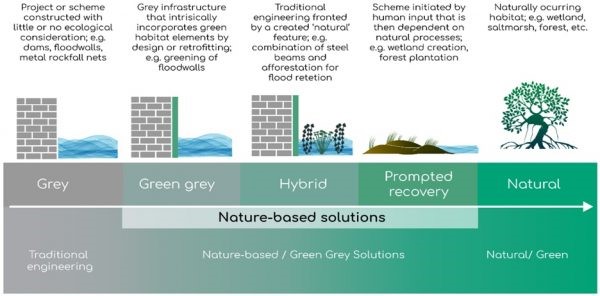
In the midst of a critical time for Europe, and with the primary concern being energy, discussions were evolving around energy neutrality, changes in cities, and addressing climate change. Following the developments in European law and the need for a “Green transformation of cities” to comply with European standards, the implementation of nature-based solutions (NBS) appeared necessary, if not mandatory.

According to the United Nations Environment Programme and the Intergovernmental Panel on Climate Change (IPCC), clear scenarios for reducing emissions were outlined. To keep the global temperature rise close to the 1.5°C target set by the Paris Agreement, net-zero CO2 emissions must be achieved by 2050. These scenarios showed that, in addition to a massive and rapid decarbonization process, significant contributions from land-based options were required. Based on the above, it has been stated that nature-based solutions provided the best way to offer these land-based options through the protection, restoration, and sustainable management of natural resources.

Furthermore, the value and significance of nature should be better reflected in economic and political decisions, with a stronger integration between biodiversity, climate change, and the development agenda. It should be also noted that a possible failure to integrate these aspects could worsen climate change and other significant social challenges.

“Climate Change: Necessary nature – based solutions (NBS)” – “The necessity of Nature-Based Solutions in the Greek legal order” – The main fields of application for nature – based solutions so far are parks and urban forests as well as the “greening” of buildings, hosted in ECOPRESS.

The discussions between the authors revolved around the necessity of “green buildings” to tackle the energy crisis and the global move towards sustainability. “Greening” the building envelope, such as green roofs, green walls, and efficient heat management, could significantly

reduce energy demand for air conditioning (40-60%) and cool the surrounding streets by 0.03°C to 3°C. Further, green roofs could also manage water effectively, potentially retaining

up to 70% of stormwater runoff.

The authors further stated that while the installation and maintenance of green systems may

seem expensive initially, the life-cycle would cost over 40 years and was comparable to traditional “black” roofs. The initial cost was just 0.4% of the total construction cost for multi – storey residential buildings.

Following the above, some critical and legal considerations were developed, such as follows:

  • The national legislation needed to be aligned with the evolving European standards (L.4067/2012, Forest Legislation, Urban Parks Legislation, Local Urban Plans, and Special Urban Plans);
  • Specifications for parks, forests, and public spaces should be revised to incorporate Nature-based Solutions (NBS);
  • Incentives should be provided to the developmental sector for ecosystem protection;
  • Afforestation should be mandatory;
  • A comprehensive reforestation program should be implemented with systematic methods, timelines, and benefit analyses.

  • Furthermore, the authors continued that public support and awareness were crucial for the successful integration of NBS. In particular, initiatives like surveys, tree planting campaigns, and citizen participation in green space creation should have been promoted at the municipality and school levels. Consequently, such collective actions would foster a sense of community and shared responsibility towards the implementation of Nbs in public spaces.