

“On Protected Areas”, article published on the website of NOMIKI BIBLIOTHIKI – NOMIKI BIBLIOTHIKI Daily.
This study seeks to examine, in a targeted manner, the contemporary institutional and legislative framework governing protected areas, while also referring to the relevant case-law of the national and European courts.
Nowadays, the task of striking a balance between the promotion of human development and the protection of the natural environment is a difficult one. And this task requires, first of all, a methodical and systematic reading and understanding of the legal framework.
It is important that our discussions, our objections and our disagreements be governed, at the very least, by a common code of understanding. The protection of the environment was not always a given, nor was it a given in law. At the founding of the Union, the founding Treaties (1957) contained no reference whatsoever to the environment. The first provisions were introduced by the Single European Act in 1987 and concerned mainly action on the environment. Some years had to pass before, with the Treaty of Maastricht in 1992, an environmental policy was instituted for the first time, which took its final form in 2009 with the Treaty of Lisbon.
In Greece, ever since, we have generally been fond of continuous changes to the legal framework. Especially in the field of Environmental Law and the special framework on Protected Areas (the Natura Network), the changes are usually combined with references to a broader reform for the benefit of environmental protection and the legal certainty of investments in the country. Every new legislative intervention, every new judicial decision, every new EU regulation in the field of protected areas ought to mark progress. On the contrary, in very many cases it adds new layers of complexity to an already dysfunctional system, while the fundamental problems remain unresolved.
▪️ How are the objectives of restoration and conservation to be achieved when the designation and protection of the existing protected areas through the Special Environmental Studies (SES) and the Protection Presidential Decrees (PDs) has not yet been completed?
▪️ How is progress to be measured when reliable baseline data are lacking?
▪️ How are the conflicts and the uncertainty between urban planning (Local and Special Urban Plans – LUPs/SUPs) and a protective regime that remains pending to be resolved?
What is the position of the Wildlife Refuges (WRs) within the new system of protected areas, and what restrictions apply to them?
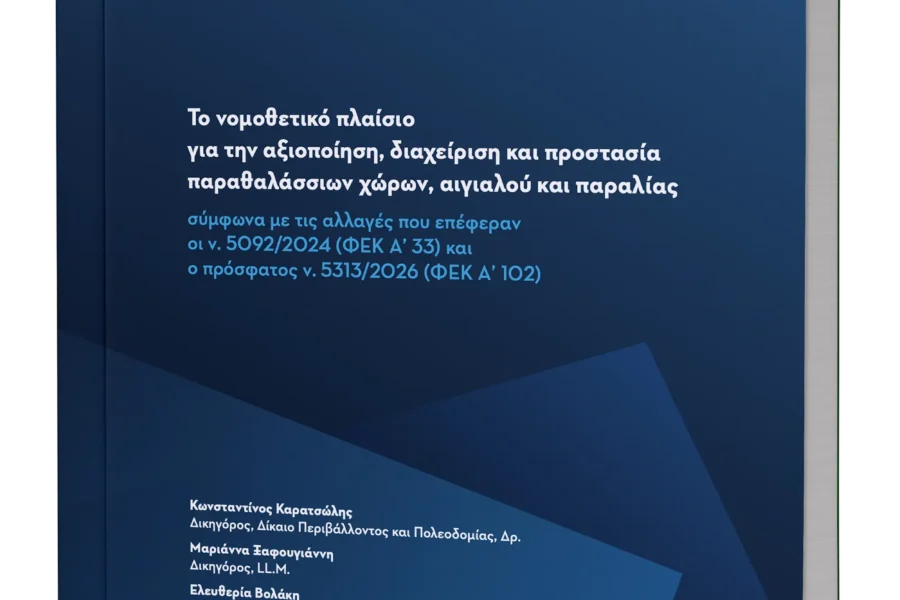
These are the questions that the second edition of the book “Protected Areas: A Legal Examination of the Contemporary Framework”, published by Nomiki Bibliothiki under the editorship of Dr Konstantinos Karatsolis, is called upon to answer.
Environmental protection must be approached in a maximalist manner, guided by the paramount importance of the natural environment in human life, with which it is inextricably and directly linked. And what does the phrase “approached in a maximalist manner” mean: it means that, whereas in other expressions of human activity and life the adverb “maximalist” is used mainly with a negative connotation (a maximalist is one who pushes matters to the extreme, who demands the maximum and risks losing even what is attainable), in matters of environmental protection the results of a maximalist stance appear to have a positive impact on the human activity of the next generation, even if today they create a negative impact and, indeed, often constitute an obstacle to development programmes. This perspective of study appears, at the outset, to be at least understandable and tolerable – something that does not occur in other branches of science.
The present study seeks to examine, in a targeted manner, the contemporary institutional and legislative framework governing protected areas, while also referring to the relevant case-law of the national and European courts. It also attempts a critical appraisal of the structural weaknesses that hinder the effective implementation of the law in force – weaknesses that affect not only ecological integrity but also the viability of development activities.